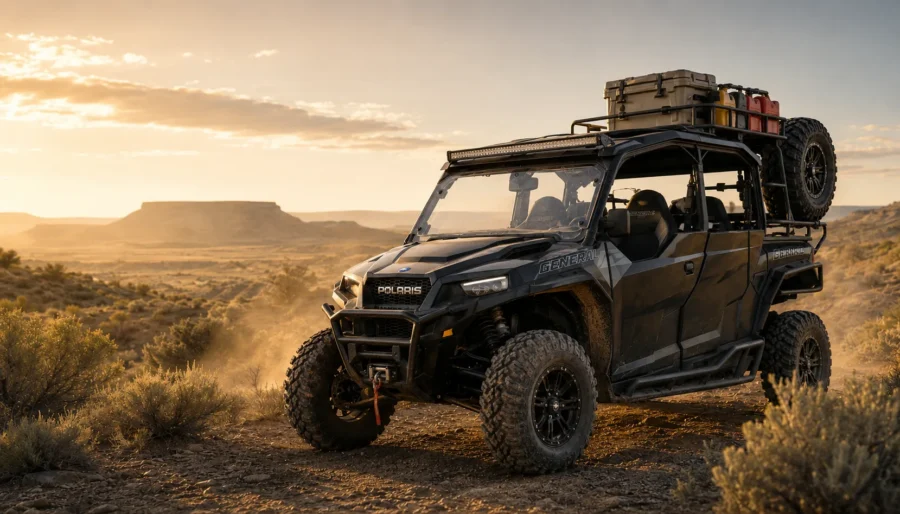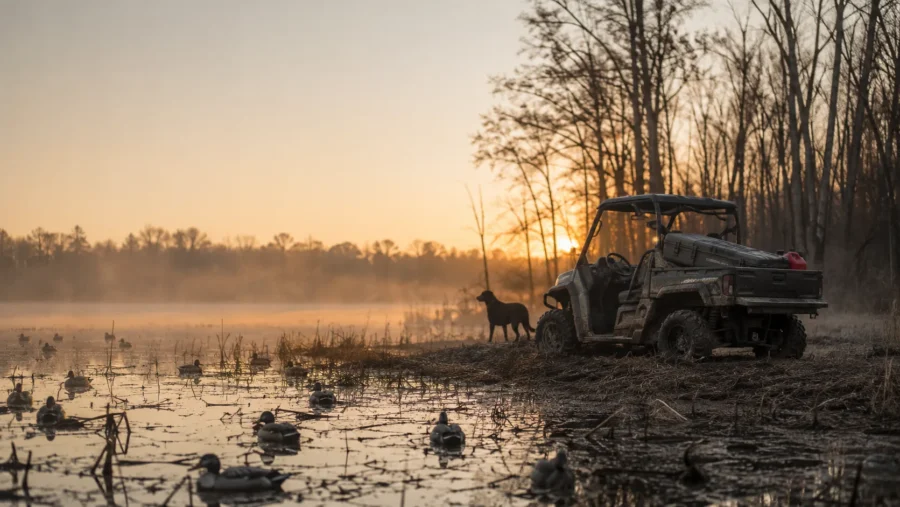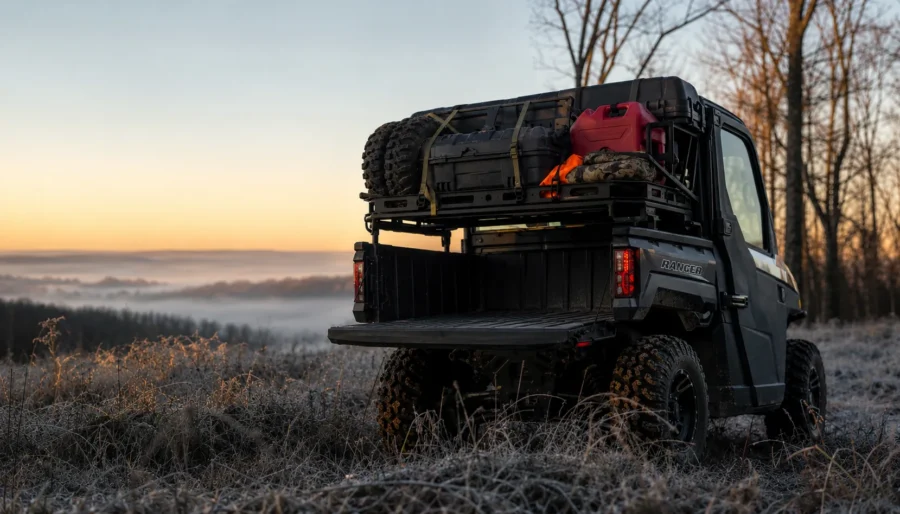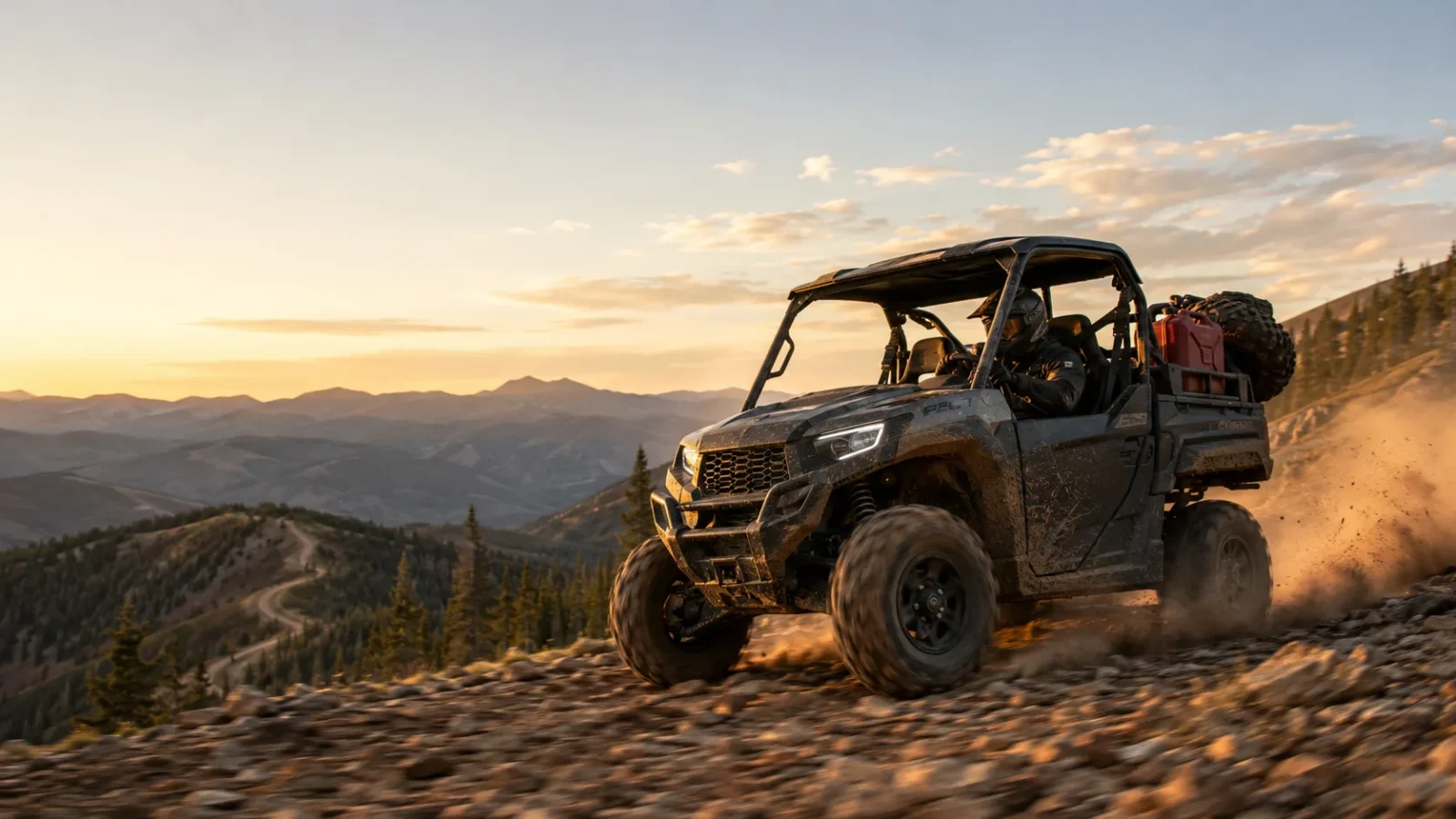
UTV trail riding is exploring off-road trails in a side by side, and a well-packed rig comes down to five things: recovery gear, a spare tire, extra fuel, sealed storage, and a way to navigate. Those are the must-haves whether you run a Polaris Ranger, a Can-Am Defender, or a CFMOTO UForce. The other question riders ask before they ever hit dirt is ATV or UTV: an ATV is narrower and cheaper and slips down tighter trails, while a UTV carries passengers and cargo and drives like a truck. Both belong on the trail. Below is what to pack, and how to make the call honestly.
What UTV trail riding actually asks of your machine
A trail ride is not a parking-lot cruise. You are hours from a paved road, often out of cell range, and the day turns on whatever you brought with you. Reputable outdoor and off-road sources land on the same short list of essentials, and it holds up in the real world: recovery gear to get unstuck, a spare tire so a puncture does not end the day, extra fuel for the long loops, sealed storage so gear rides dry, and navigation so you get back before dark. The rule they all repeat is simple. The one day you leave the spare, the fuel, or the water behind is the day you need it.
None of that is machine-specific. A Ranger, a Defender, a General, and a UForce all want the same core kit. What changes is where each part bolts on, which is where a modular mounting system earns its keep. Build the base once, and it rides across seasons and across trails.
The five trail must-haves (and where to bolt them)
This is a mini-loadout, not a product roundup. Five jobs, real parts, honest prices. Skip the ones you already have. For the full category-by-category build, the Best UTV Accessories guide walks the whole tree.
1. Recovery: get unstuck without a tow
Mud, ruts, and off-camber ledges are where a trail day goes sideways. The heavy lifter for recovery is a winch, and we do not stock a winch line, so this is one place we point you straight to the maker rather than sell you something we do not carry. Warn and KFI both build powersports winches sized for a UTV: buy the winch from them and match it to your machine and mounting point. If you would rather skip a winch, traction boards, a folding shovel, and a pair of recovery straps handle most stuck situations, and a spotter who knows how to rig a pull matters more than any single tool. Whatever you run, keep the recovery kit sealed and strapped down so it is there when the trail turns bad.
2. A spare tire that survives the trail
A flat two miles down a rutted two-track is the single most common way a ride ends early. Carry a spare on a proper mount, not loose in the bed. For a bed mount, the Bed-Mount Spare Tire Carrier for Polaris Ranger (~$250) holds a full-size spare and clears out when you need the space. If you would rather keep the bed open, the Roll Cage Spare Tire Carrier (~$130) clamps a spare to the cage and fits a range of machines with a compatible roll cage, so it is the closest thing to a universal option here. Machine-specific carriers exist too, like the UTV Spare Tire Holder for Can-Am Defender (~$150) and the Spare Tire Carrier Mount for Polaris RZR XP 1000 (~$125). Full list at spare tire mounts.
3. Extra fuel for the long loops
Trails burn more fuel than the odometer suggests, and the good spots are the far ones. A RotoPax 2 Gallon Gasoline Pack (~$110) is made in the USA, sealed, and built not to leak or vibrate loose over washboard, and because RotoPax packs stack on a shared mount you can add a second pack or a water pack on the same base. Mount it with a RotoPax pack mount like the RotoPax L-Bracket (~$50), which bolts to a flat rack surface and locks the pack down. For water on hot rides, matching RotoPax water packs share the same mounting system, so one base carries fuel and water both. Browse fuel storage for the full range in gas, diesel, and water.
4. Storage that keeps gear on the machine
Loose totes bounce out. The fix is a rack you can strap to, plus lockable boxes for the gear you do not want sliding around. A rear cargo rack is the foundation: the Heavy Duty Rear Cargo Rack for Polaris Ranger (~$300) gives you a raised aluminum tray and tie-down points to build on. For gear you want out of the weather and locked, the 21L Locking Bed Storage Box for Polaris Ranger (~$140) is a lock-and-key box, and a Stretchable Cargo Bed Net for Can-Am Defender (~$60) pins down the odd-shaped loads a box will not hold. For the small stuff in the cab, a Roll Cage Storage Bag for Polaris Ranger (~$50) clamps to the cage and keeps tools and snacks in reach. Start at the cargo racks category or the broader storage hub.
5. Navigation you can trust off the grid
Cell coverage disappears on most trail systems, so a phone map is a backup, not a plan. A dedicated off-road GPS with preloaded trail maps is the honest recommendation here, and we do not make one, so this link goes straight to the maker. The Garmin Tread 2 SxS Edition is a purpose-built pick: an 8-inch ultrabright, glove-friendly touchscreen rated IP67 for dust and water, with turn-by-turn trail navigation from OpenStreetMap, U.S. Forest Service Motor Vehicle Use Maps, and Garmin's Adventure Roads and Trails data, plus public-land boundaries baked in. It ships with a tube mount kit sized for UTV and side-by-side roll bars, so it bolts to the same cage your other gear rides on. Pair it with a paper map and compass as the no-battery fallback, the way every essentials list recommends.
ATV vs UTV for trail riding, the honest call
Riders shopping their first machine ask this constantly, and the honest answer is that neither wins outright. They are built for different trails.
An ATV is a single-rider quad with handlebar steering, and per Polaris most are designed for one rider (some seat two). It is narrower, lighter, and cheaper, and it slips down tight, brushy trails and restricted routes that a full-size side by side cannot enter. It also fits in the bed of most full-size pickups, so transport and storage are easier. The trade-off: you steer it with your body, there is no cargo bed, and it carries one person and a rack's worth of gear.
A UTV, or side by side, seats 2 to 6 people with a steering wheel, foot pedals, seatbelts, and a roll cage, per Polaris. It has a cargo bed, hauls and tows real loads, and drives like a truck, which makes it the pick for group rides, hunting hauls, and any day where cargo matters. The trade-off is width and price: it is larger and less nimble on tight trails, and it costs more. Polaris notes that narrower 50-inch side-by-side models can access some restricted routes that wider rigs cannot, so trail access is not strictly ATV-only.
The money side is real too. Polaris puts average ATV pricing around ~$5,000 to ~$15,000 and average UTV pricing around ~$10,000 to ~$30,000. For a solo rider on tight single-track, an ATV is often the smarter buy. For a family, a hunting crew, or anyone hauling gear, a UTV usually earns its keep, and one machine that carries everyone can beat buying several ATVs. Both are trail-worthy. Match the machine to how you actually ride.
Here is the same call laid out attribute by attribute. All values come from Polaris's April 2025 ATV vs UTV buying guide; the price bands are Polaris's stated averages, flagged approximate.
| Attribute | ATV | UTV (side by side) | Source |
|---|---|---|---|
| Seating | 1 rider (some 2-person models) | 2 to 6 people | Polaris (Apr 2025) |
| Steering / controls | Handlebars, body-steered | Steering wheel, foot pedals, seatbelts, roll cage | Polaris (Apr 2025) |
| Cargo bed | None (cargo racks / towing only) | Rear cargo bed; hauls and tows | Polaris (Apr 2025) |
| Trail access | Narrowest; fits tight, restricted trails | Wider; 50-inch models access some restricted routes | Polaris (Apr 2025) |
| On tight trail | Most maneuverable | Larger, less nimble | Polaris (Apr 2025) |
| Transport | Fits most full-size pickup beds | Typically needs a trailer | Polaris (Apr 2025) |
| Price band | ~$5,000 to ~$15,000 (approx.) | ~$10,000 to ~$30,000 (approx.) | Polaris (Apr 2025), avg. bands |
| Best for | Solo rider, tight single-track, tighter budget | Passengers, cargo, hauling, group rides | Polaris (Apr 2025) |
Frequently asked questions
What do I need for UTV trail riding?
Five must-haves cover most trail days: recovery gear (traction boards, a shovel and straps, or a winch), a spare tire on a proper mount, extra fuel in a sealed pack, modular storage that locks gear to the machine, and reliable navigation. Water, a first-aid kit, and a way to communicate round it out. The gear is largely cross-machine, so a Ranger, Defender, or UForce can run the same core kit.
What is the best GPS for UTV trail riding?
A dedicated mounted off-road GPS with preloaded trail and public-land maps is the standard choice, because cell coverage disappears on most trail systems and a phone map cannot be trusted alone. A purpose-built option is the Garmin Tread 2 SxS Edition: an 8-inch glove-friendly touchscreen rated IP67 for dust and water, with turn-by-turn trail maps and public-land boundaries and a tube mount for side-by-side bars. Whatever unit you pick, look for preloaded off-road maps, offline navigation, and a rugged, weather-sealed housing, then carry a paper map and compass as the no-battery backup that every reputable essentials list recommends.
ATV or UTV for trail riding, which is better?
Neither wins outright; they suit different trails. An ATV is narrower, lighter, and cheaper, so it excels on tight single-track and restricted routes and hops in a pickup bed. A UTV seats 2 to 6, has a cargo bed, and drives like a truck, so it wins for passengers, hauling, and group rides. Match the machine to how you ride, not to a spec sheet.
Can a UTV go on the same trails as an ATV?
Often, but not always. Many trails welcome both, though the tightest, narrowest routes are sometimes gated to ATVs and dirt bikes only. Polaris notes that narrower 50-inch side-by-side models can access some restricted trails that wider rigs cannot, so trail access depends on the specific route and your machine's width. Always check the trail system's width rules before you go.
How much fuel should I carry for a trail ride?
Enough to cover the loop plus a real reserve, because trails burn more than street miles and the good spots are far out. A 2-gallon spare pack, like a sealed RotoPax, is the common add for a full day. Mount it in a sealed, vibration-resistant carrier rather than loose in the bed, and top off before you leave the trailhead, not after you are already low.
From MaxtOffroad
The trail part we point riders to first is not the flashy stuff, it is the spare-tire mount. A flat two miles out turns into a long walk without one. The Roll Cage Spare Tire Carrier (~$130) clamps a full-size spare to the roll cage and fits a range of machines with a compatible cage, so it is the closest thing to a one-part answer across a mixed garage. We like that it rides on the same cage that carries your lights and mirrors, because a trail rig should be one base you build on, not a pile of one-off brackets. Get the spare handled first, and the rest of the kit falls in behind it.